
LUX PICTURA
RESEARCH PROJECTS
IN PHOTOGRAPHY
HISTORY OF PHOTOGRAPHY
The invention of photography is not the invention of one man, it is the ongoing effort of many who, through research, have paved the way to understanding how to capture light and how to preserve it. The invention of Joseph Nicéphore Niépce, who first succeeded in capturing a delicate, but lasting and permanent image, is crucial for photography in today's sense. Later, Jean Louis Daguerre took up his work and in 1839 developed the first useful photographic process, named after him - the daguerreotype. The French government bought the patent and gave the invention of photography to the world, with one exception - the English were not allowed to use the process without paying high royalties for the use of the patent.
At this time in the UK, William H. Fox Talbot invented his own photographic process, calotype/talbotype, which was very different from daguerreotype. The daguerreotype was made on a silver-plated copper plate and had exceptional resolution and sharpness, but it was inimitable and usually could not be copied. The calotype was completely different, very soft-looking and made on paper that was waxed to produce a negative that could be reproduced and countless identical copies could be made.
At this time in the UK, William H. Fox Talbot invented his own photographic process, calotype/talbotype, which was very different from daguerreotype. The daguerreotype was made on a silver-plated copper plate and had exceptional resolution and sharpness, but it was inimitable and usually could not be copied. The calotype was completely different, very soft-looking and made on paper that was waxed to produce a negative that could be reproduced and countless identical copies could be made.
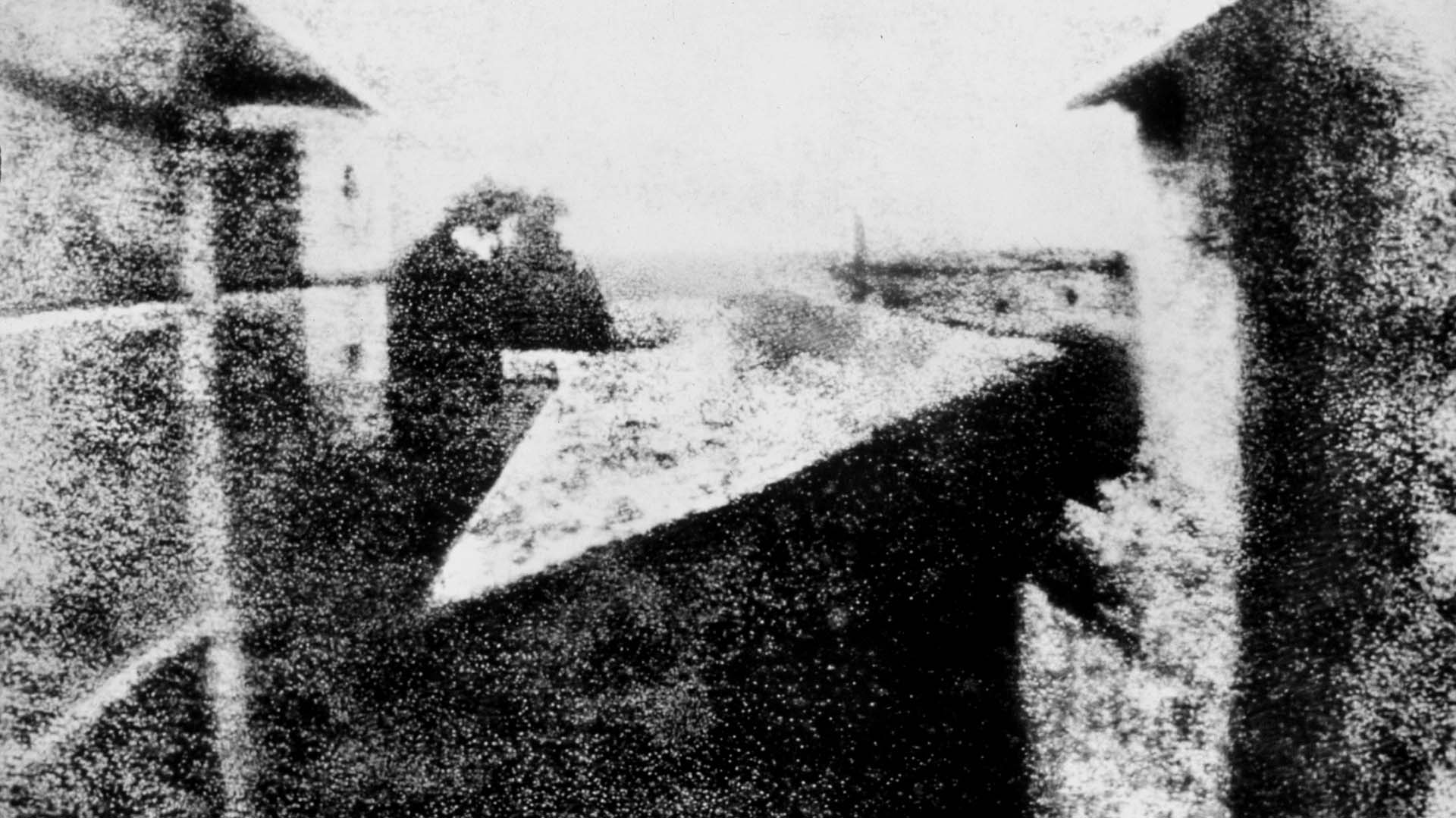
1826Nicéphore Niépce captures the first enduring photograph
The first permanent photograph, "View from the window of the La Gras estate near Saint-Loup-de-Varennes", was taken in 1827 by Joseph Nicéphore Niépce. It was shot on a tin plate coated with bitumen resin, which was exposed in camera obscura for 8 hours.1839The invention of the daguerreotype is presented in Paris.
After Niepce's death, Louis Jacques Mandé Daguerre continued and built on his work, inventing the daguerreotype, renowned for its incredible resolution, sharpness and contrast.1839W.H. Fox Talbot presents photogenic drawings.
Talbot creates contact prints of objects on paper coated with sodium chloride and silver nitrate.1841W. H. Fox Talbot invents calotypy
W. H. Fox Talbot builds on his photogenic drawing process and creates a calotype process that uses a paper negative that is contact-printed into a paper positive. This opens the window of the negative-positive principle.1842Sir John Herschel invents cyanotypy
The invention of the simple process of cyanotype becomes widely used in the world of quick document copies, but it also has its use value in the artistic expression of some.1851Invention of the wet-colodion process on glass
The invention of the wet plate process represents a radical step in the development of photography, as F.S. Archer manages to combine the advantages of the daguerreotype with its sharpness and of the calotype with its ability to reproduce the negative quickly on paper.
SLOVENIAN PHOTOGRAPHERS IN THE 19TH CENTURY A CENTURY
The project "Slovenian Photographers 1839-1880" is an attempt to create a comprehensive overview of the history of Slovenian photography from its beginnings until 1880, which became a turning point in the development of photography both in Slovenia and worldwide with the invention of the dry gelatine plate. In our continuous research into early photographic processes, we have found that the Slovenian space is poorly researched and, apart from a few individuals who have published their findings in professional publications, there is no major research focus on forming an overall picture of how Slovenian photography developed, who were the most important witnesses and drivers of its development, and what are the top examples of Slovenian photography with which we can compare ourselves to the major European nations.
The emerging work is based on archival research, networking with museums and curators, and collaboration with experts in the history of Slovenian photography. The aim of the project is to publish a professional photomonograph highlighting the first Slovenian photographers and their work in the form of a comprehensive catalogue for both the general and professional public. The project also includes a comprehensive exhibition of early Slovenian photography, which will include a wide range of works by some private collectors and a selection from Slovenian museum repositories.
The emerging work is based on archival research, networking with museums and curators, and collaboration with experts in the history of Slovenian photography. The aim of the project is to publish a professional photomonograph highlighting the first Slovenian photographers and their work in the form of a comprehensive catalogue for both the general and professional public. The project also includes a comprehensive exhibition of early Slovenian photography, which will include a wide range of works by some private collectors and a selection from Slovenian museum repositories.